 English
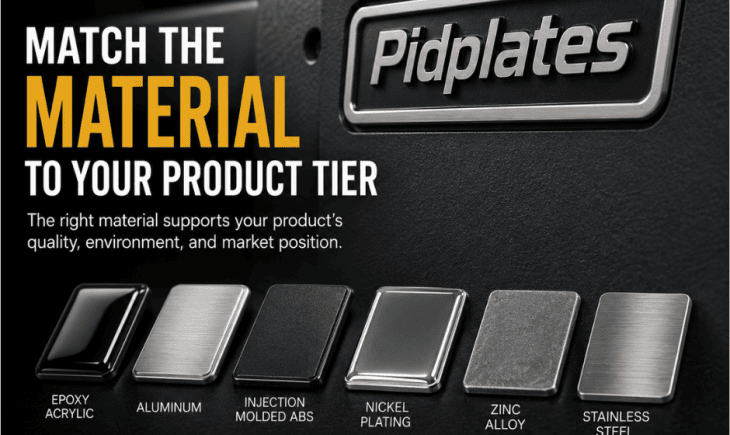
In the previous part of this guide, we explained why the product surface is one of the first factors to consider when choosing a custom 3D emblem. Once the surface and application are understood, the next step is selecting a material that supports the product’s quality, environment, and market position.
Different products require different material choices. The best material is not always the most expensive or premium-looking option. It is the one that creates the right balance between appearance, performance, durability, and cost.
Different materials serve different products and different operating environments.
So, the question is not, “Which material looks most premium?” The better question is, “Which material makes sense on this product, at this price point, in this category?”
Here’s how different 3D emblem materials are commonly used.
| Material | Best for | Why |
|---|---|---|
| Injection-molded ABS | Indoor commercial, light industrial | Dimensionally stable, consistent across long runs, cost-effective at volume |
| Aluminum | Outdoor-facing and marine equipment | Corrosion-resistant, clean edge, anodizable for color matching |
| Zinc alloy | High-touch products: tools, HVAC, power equipment | Heavier and denser than ABS. The weight registers as quality in the hand |
| Stainless steel | Products exposed to frequent cleaning or chemical washdown | Strong finish integrity, and a clean, durable look for demanding applications |
| Epoxy resin/ acrylic | Brand marks requiring depth and gloss | Produces visual depth a metal surface can’t and suits complex or colorful logo designs |
| Nickel plating | Fine detail work at a small scale | Holds tight letterforms and small geometry that would lose definition in an ABS mold |
At PidPlates, we offer these materials and more to give manufacturers room to match their custom 3D emblem to their product instead of forcing one material across every use case.
The material choice behind a custom 3D emblem can influence more than appearance. It affects how customers perceive quality, how the emblem performs over time, and how well it fits the product’s intended environment.
At PidPlates, we help manufacturers compare materials, finishes, and construction methods to create emblems that match their product requirements and brand standards.
If you’re deciding which material is right for your product line, contact PidPlates to discuss your application and request a free quote with a 3D mockup option.
In the next part of this guide, we’ll explore how environmental conditions can impact emblem durability and why choosing the right solution requires more than just appearance.