PidPlates custom 3D emblems and custom metal badges for industrial products

In the previous part of this guide, we explained why planning your emblem early in the product development process helps manufacturers avoid limitations and achieve better production results.

Custom 3D emblems increase product value when they make the product’s quality visible before anyone reads the spec sheet.

But that only happens when the emblem fits the product.

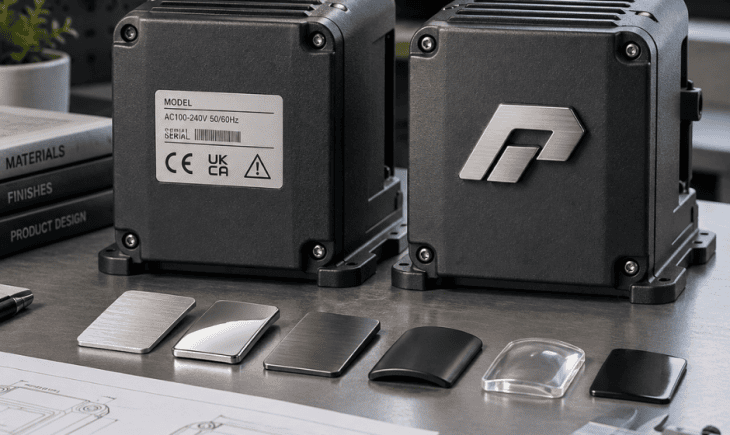
A heavy metal badge can look excellent on a rigid equipment panel and completely wrong on a lightweight molded cover. A glossy raised decal can add the right depth to a consumer-facing product, but feels out of place on a matte industrial housing.

That’s why deciding on the best choice starts with the product itself.

When the  custom 3D emblem looks like it belongs on that exact product, survives where the product lives, and gives the brand mark real physical presence, it helps the finished product feel more durable and easier to trust.

If you’re working on a B2B product line and want to see what the right emblem looks like on your product, PidPlates can help.

Request a free quote, and you’ll receive a free 3D mock-up file with it.

And if you want to feel the quality before you commit, ask for a free sample when you get in touch. We’ll send one out so you can assess the look, feel, and finish in person before placing an order.


Choosing the right emblem is not only about appearance. It is about selecting a solution that supports your product, your customers, and your brand standards.

At PidPlates, we help manufacturers create custom branding solutions that match their products, production requirements, and long-term goals.


PidPlates custom 3D emblems planned for consistent production and product branding

In the previous part of this guide, we explained why a custom 3D emblem must be designed to survive the real conditions where the product will be used.

Production planning is the next step in making sure the emblem fits the product, the manufacturing process, and the final customer experience.

The worst time to think about the emblem is after the product design is finished.

By then, the surface may already be too small, too curved, too textured, or too crowded. So, the emblem gets squeezed into whatever space is left, and everyone pretends that was the plan all along.

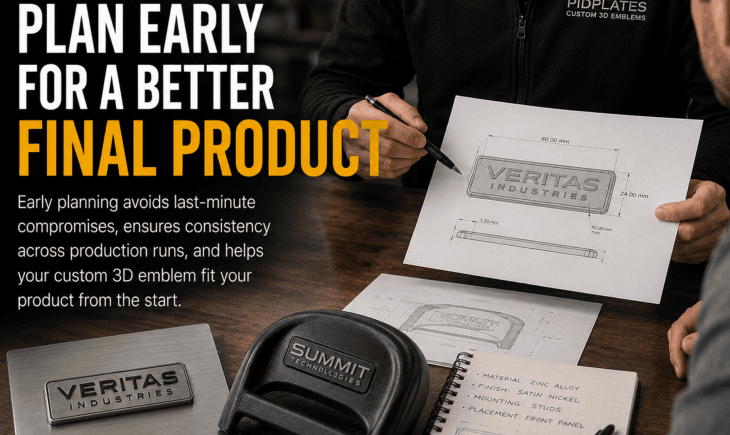
Early thinking helps your product team avoid awkward compromises later. From the start, they know to add a few millimeters of extra space on the housing. Or make a cleaner flat area on the panel for the emblem.

Additionally, consistency matters for B2B production runs. If the same brand mark will appear across 100+ units, or across  multiple product lines, you need repeatable height, finish, material, color, placement, and mounting.

You’ll get a cleaner result if the emblem is considered earlier.

A well-planned emblem design helps manufacturers avoid unnecessary changes during production and creates a more consistent final product.

At PidPlates, we work with manufacturers during the development process to help create custom 3D emblems that fit their products from the beginning, not as an afterthought.

Whether you need help selecting materials, planning placement, or preparing your emblem for production, our team can help you  find the right solution.

In the next part of this guide, we’ll bring everything together and explain how choosing the right emblem can help create stronger product value, better brand perception, and a more finished industrial product.

PidPlates custom 3D emblems designed for durability in demanding environments

In the previous part of this guide, we explored how material selection affects the appearance, performance, and value of a custom 3D emblem. However, choosing the right material is only part of the process.

A successful emblem must also be able to handle the conditions it will face after the product reaches the customer. The environment, handling, and application requirements should influence the design from the beginning.

Your emblem has a life after the product is bought.

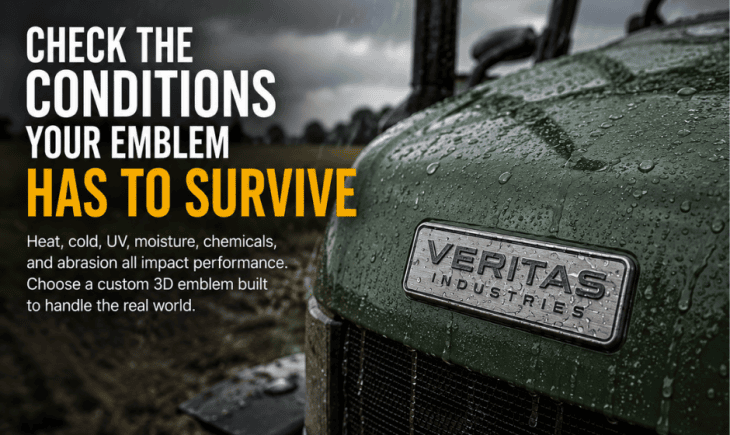
It may be handled daily. Cleaned weekly. Shipped in bulk. Stored outdoors. Installed on a vibrating panel. Exposed to moisture, sun, dust, oil, abrasion, or temperature swings.

These conditions should shape the spec early.

Even two products with the same emblem may need different materials or mounting methods because their environments are not the same.

For example, an emblem on indoor consumer packaging has a different job from one on a marine product. A badge on construction equipment needs different thinking from one on a retail display fixture.

Adhesive choice also matters. A good adhesive on the wrong surface can still fail. Surface texture, coating, curvature, and exposure all affect how well the emblem stays attached.

If your emblem has to survive real use, don’t choose it like a sticker. Choose it like a product component.

A custom 3D emblem should be designed for the environment where it will operate, not just how it looks during the approval stage. Durability, attachment method, and material performance all contribute to the long-term success of the final product.

At PidPlates, we help manufacturers develop custom emblems that are built around real application requirements, including outdoor exposure, industrial handling, cleaning conditions, and demanding operating environments.

If you need help selecting the right emblem solution for your product, contact PidPlates to review your application and request a free quote with a 3D mockup option.

In the next part of this guide, we’ll discuss why considering the emblem early in the production process can help manufacturers avoid design limitations and create better final results.

Custom 3D emblems in different materials and finishes by PidPlates

In the previous part of this guide, we explained why the product surface is one of the first factors to consider when choosing a custom 3D emblem. Once the surface and application are understood, the next step is selecting a material that supports the product’s quality, environment, and market position.

Different products require different material choices. The best material is not always the most expensive or premium-looking option. It is the one that creates the right balance between appearance, performance, durability, and cost.

Different materials serve different products and different operating environments.

So, the question is not, “Which material looks most premium?” The better question is, “Which material makes sense on this product, at this price point, in this category?”

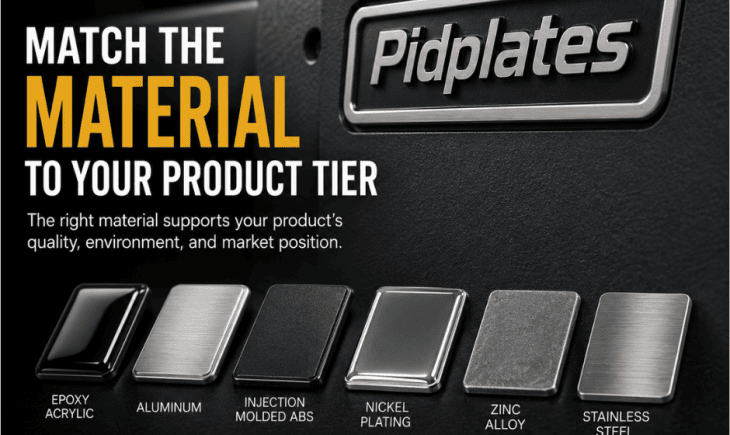
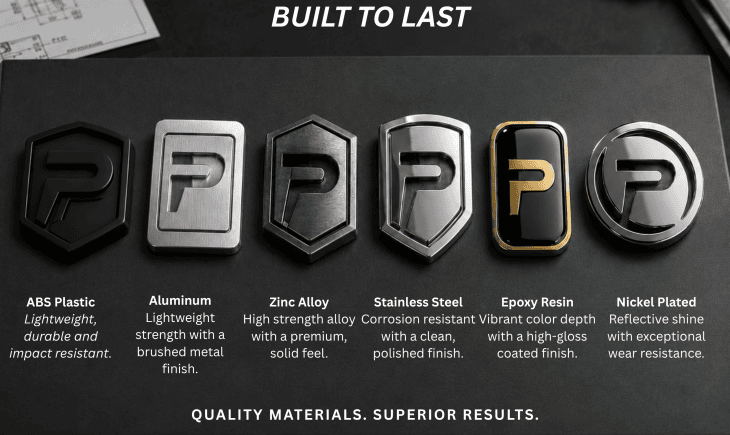
Here’s how different 3D emblem materials are commonly used.

Material Best for Why
Injection-molded ABS Indoor commercial, light industrial Dimensionally stable, consistent across long runs, cost-effective at volume
Aluminum Outdoor-facing and marine equipment Corrosion-resistant, clean edge, anodizable for color matching
Zinc alloy High-touch products: tools, HVAC, power equipment Heavier and denser than ABS. The weight registers as quality in the hand
Stainless steel Products exposed to frequent cleaning or chemical washdown Strong finish integrity, and a clean, durable look for demanding applications
Epoxy resin/ acrylic Brand marks requiring depth and gloss Produces visual depth a metal surface can’t and suits complex or colorful logo designs
Nickel plating Fine detail work at a small scale Holds tight letterforms and small geometry that would lose definition in an ABS mold

At PidPlates, we offer these materials and more to give manufacturers room to match their custom 3D emblem to their product instead of forcing one material across every use case.

The material choice behind a custom 3D emblem can influence more than appearance. It affects how customers perceive quality, how the emblem performs over time, and how well it fits the product’s intended environment.

At PidPlates, we help manufacturers compare materials, finishes, and construction methods to create emblems that match their product requirements and brand standards.

If you’re deciding which material is right for your product line, contact PidPlates to discuss your application and request a free quote with a 3D mockup option.

In the next part of this guide, we’ll explore how environmental conditions can impact emblem durability and why choosing the right solution requires more than just appearance.

PidPlates custom 3D emblems designed for different product surfaces

In the first part of this guide, we explained that choosing a custom 3D emblem is not only about selecting a design that looks attractive. The right emblem must match the product, surface, environment, and expectations of the market it serves.

Now that you understand when a 3D emblem makes sense for an industrial product, the next step is knowing how to choose the right option.

Choosing the right emblem is less about picking the nicest-looking finish and more about matching the emblem to the product it has to live on. Here are four practical tips for choosing the right 3D emblem for your industrial product.

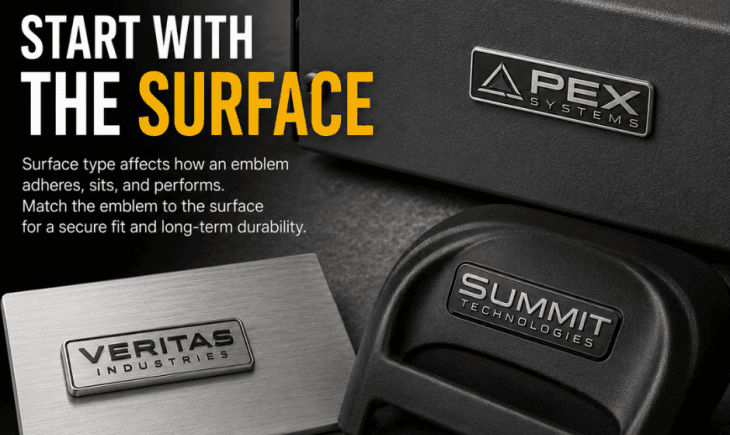
Tip #1: Start with Your Product Surface

Your emblem has to meet the surface before it meets your buyer.

Is the surface flat or curved? Smooth or textured? Painted, powder-coated, molded, brushed, plated, or polished? Is it plastic, metal, glass, composite, or coated material?

A flat equipment panel may need a rigid metal badge. A curved appliance panel needs a pre-formed emblem. A textured powder-coated surface needs a different adhesive than smooth painted metal.

This is where many emblem decisions go wrong. The emblem looks good in the mockup, but the real surface tells a different story.

Starting with the surface makes sure your custom 3D emblem looks like it belongs on the product body, not like it was added as an afterthought.
 

The product surface is one of the first factors that determines how well an emblem performs and how naturally it integrates with the finished product. A proper match between the emblem and the application helps create a cleaner, more professional result.

At PidPlates, we help manufacturers select the right emblem construction, finish, and mounting approach based on their specific product needs. Our team works with you to develop a solution that fits your application and brand requirements.

If you’re evaluating a custom 3D emblem for your industrial product line, contact PidPlates to discuss your project and request a free quote with a 3D mockup option.

In the next part of this guide, we’ll explore how choosing the right material can impact durability, appearance, and the overall value of your product branding.

Premium industrial products comparing branding methods, including a custom 3D metal emblem by Pidplates, a printed label, a screen printed logo, and a standard decal.

Some branding companies may not tell you this, but we’ll say it plainly.

Custom 3D emblems aren’t automatically the right choice for every product, surface, or price point. Sometimes a flat label, printed logo, screen-printed mark, rating plate, or standard decal is the smarter decision.

If your product is temporary, hidden during normal use, built for a very low-cost category, or likely to take constant surface damage, a 3D emblem may add cost without adding enough buyer-visible value.

A study on 3D printed personalized products found that people rated them higher than standard versions on perceived value measures. But willingness to pay did not rise enough to cover higher production costs in every product category.

That’s a useful warning to remember that value must survive the spreadsheet.

3D emblems work best when the buyer or end-user sees the brand mark during evaluation or use, when the product’s price point supports the material choice, and when the operating environment is one the emblem can actually survive.

If your industrial product meets these criteria, the next question is how to choose the right 3D emblem. Continue reading to learn how.

A custom 3D emblem should do more than simply display a logo. It should support the way your product is perceived, handled, and remembered.

At PidPlates, we help manufacturers evaluate the right emblem style, material, and construction method for their specific application. Whether you need a premium brand badge, a durable industrial emblem, or a custom solution designed around your product requirements, our team can help guide the process.

Visit PidPlates to explore custom branding solutions for industrial products, or contact our team to discuss your project and request a free quote with a 3D mockup option.

PidPlates USA explains how surface, material, environment, and production volume impact custom 3D emblems for industrial product branding.

What types of products benefit most from 3D emblems?

Custom 3D emblems work best on products where the buyer or end-user sees the brand during evaluation, purchase, installation, or daily use.

That includes industrial equipment, tools, appliances, outdoor gear, automotive and mobility products, marine products, retail fixtures, luxury packaging, consumer products, and commercial equipment.

The emblem has more value when it sits on a visible surface and supports the product’s category. If your buyer never sees the mark, or the product is hidden after installation, a simpler marking method may make more sense.

What should manufacturers consider before ordering 3D emblems?

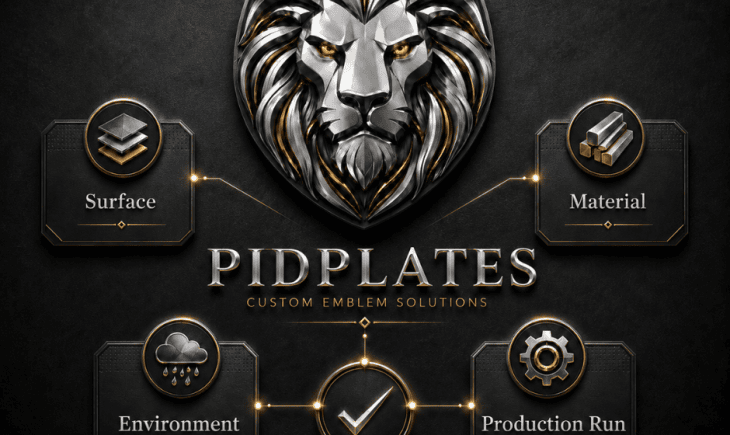
Consider four things first: surface, material, environment, and production volume.

You need to know where the emblem will sit, what that surface is made from, what conditions the product will face, and how many units need the same result. Then, you can choose the material, finish, height, adhesive or mounting method, and edge profile.

The earlier you make those decisions, the cleaner the final product usually looks. Plus, a custom 3D emblem that was part of the original product brief costs less than one specified after production. 

A well-chosen emblem gives your buyer one more reason to trust the product. It’s a small detail, but it gives a big signal. 

If you’re looking to specify custom 3D emblems for your B2B product line, PidPlates can help you match the emblem construction to your product and brand standards. 

Request a free quote today, and you’ll also receive a free 3D mockup file. 

Upon request, we can also send free generic 3D product samples, so your team can review the look, feel, and quality before moving forward. 

Custom 3D car emblems and metal badges by PidPlates by Mark, including chrome emblems, custom metal logos, raised decals, and OEM branding solutions.

Custom isn’t about being elaborate. It’s about control.

Off-the-shelf badges and generic emblem formats give you a shape someone else designed, a finish someone else chose, and a size that may or may not fit your product correctly. 

You can make them work like plenty of manufacturers do. But you’d be fitting your brand into someone else’s template, and the result usually doesn’t look good.

Custom 3D emblems give you control over the things that determine whether the emblem belongs on your product. 

You can control the shape, height, finish, edge profile, color, material, mounting method, and production consistency. You can also make the emblem fit across a product family, so your entry-level model, premium model, and flagship unit feel connected without looking identical.

That’s hard to do with generic branding parts that you choose from a drawer, and hope looks good. 

And for B2B production runs, consistency is not a nice extra. If your emblem appears on 100, 1,000, or 10,000 units, every piece needs to carry the same finish, sit in the same position, and support the same product promise. 

At PidPlates, we offer various types of custom 3D emblems to our B2B clients. 

Whether it’s a custom plastic emblem that blends cleanly with a molded housing. Or a custom metal emblem that gives your equipment faceplate a more solid look. Or a nickel, aluminum, zinc alloy, stainless steel, epoxy resin, or acrylic finish.

You can count on us to deliver a custom 3D emblem that fits your product surface, supports your brand standard, and holds its own in real-world use. 

Conclusion: Make Your Emblem Earn Its Place 

Custom 3D emblems won’t fix weak engineering. And a low-cost product won’t turn into a premium one just because the logo is raised on the surface.

But when your product is already built to feel durable, technical, high-end, or carefully specified, the emblem should not be the weakest detail on the housing. It should support your product’s promise.

That might mean a custom metal emblem on a rugged equipment panel. Or, a lightweight ABS emblem on a curved molded cover. Or an aluminum badge for a piece of industrial equipment that needs to feel precise without looking flashy.

The point is not to add decoration. It’s to showcase your product’s quality. 

A well-chosen emblem gives your buyer one more reason to trust the product. It’s a small detail, but it gives a big signal. 

If you’re looking to specify custom 3D emblems for your B2B product line, PidPlates can help you match the emblem construction to your product and brand standards. 

Request a free quote today, and you’ll also receive a free 3D mockup file. 

Upon request, we can also send free generic 3D product samples, so your team can review the look, feel, and quality before moving forward. 

3D custom emblem on an industrial product helping brands stand out in competitive markets

They help your product stand apart in a crowded category

Most industrial products aren’t just picked out of the blue.

Your buyer may be comparing three equipment suppliers, five component options, or two product ranges that all claim the same basic things. Strong build, reliable performance, clean finish, long service life, and competitive pricing.

So, the brand becomes one of the few visible signals that separates your product on a distributor’s floor or in a product comparison.

A 3D emblem gives your product a stronger identity. It makes your product visually distinct in a way flat labels can’t, and it can be specified to match your exact brand geometry.

This matters most when your product has to compete in a category where the shape is mostly fixed. Instead of your product looking like one more unit in the row, a 3D emblem makes it look a tier above the ones that don’t.

The prospective buyer may not say, “Ha, yes, this raised emblem has increased my perception of product value.” But they’ll notice that your product looks more finished, and they’ll remember it easily.

In many cases, that improved perception is what determines whether a product is shortlisted or overlooked during final supplier comparisons.

For manufacturers and brand teams looking to explore how this applies to their own line, the next step is typically a brief review of design specifications and material requirements to determine the most suitable 3D emblem options for production, often supported by supplier input during early-stage evaluation. More information is available here.

Premium 3D industrial emblem designed to maintain appearance and durability on products

They support trust when they survive your product environment

A good label has to keep its promise after installation.

That’s the part many “premium branding” conversations skip. Your label may look excellent in a product photo, but your buyer is not buying the photo.

They’re buying the product that gets handled, cleaned, stored, shipped, installed, exposed, and used.
And a logo that lifts at the edge after a few months doesn’t make your product feel premium. It makes your buyer wonder what else wasn’t created to last long.

A study on 3D printed branded accessories found that functional and kinesthetic design perception had a significant direct impact on consumer-based brand equity.

In plain English, people didn’t only respond to whether the product worked well. They responded to how the product looked.

A 3D emblem belongs on the product physically, not just visually. It sits cleanly on the surface, holds through normal use, and ages in a way that still supports the product’s value.

It looks good on day one and is designed to maintain its appearance over time, even under regular handling, cleaning, and product use.

For manufacturers exploring custom 3D emblems for B2B applications, solutions like those from PidPlates are often used to align emblem construction with product requirements and brand standards.

In many cases, teams start with a basic review of design options or a prototype mockup to evaluate how the emblem integrates with the final product before moving into production.